
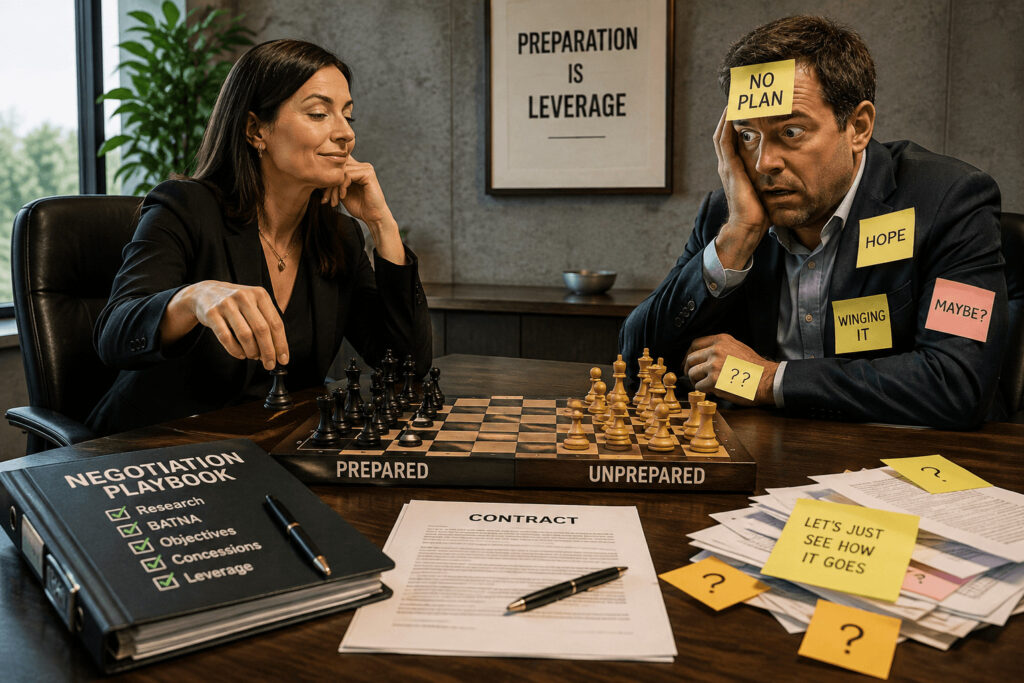
What Power Means in Contract Negotiations
When you find yourself in a situation to negotiate contracts, that’s when people start to realize that you have to humanize the contracting process to understand the contracting process from the beginning to the end. In contracting this is referred to as cradle to grave. Contracts don’t negotiate themselves with minimal human interaction. Consider some of the challenges that come with negotiating contracts. One of the most challenging situations is establishing power in negotiations.
What people perceive as power and what happens in real time during negotiations are two different things. Power is the ability to influence without force. Power is not aggressive one-sided negotiations with no willingness to compromise. This approach is highly ineffective.
Preparing Before the Negotiation Phase
In an ideal situation, there are preparations that occur prior to starting the negotiations phase of the contracting process. If you step into a negotiation without internal stakeholder approval, you’re going to find yourself up a creek without a paddle. Highly skilled negotiators will be actively listening to their internal stakeholders, asking lots of questions up front: What are you willing to negotiate? What is a deal breaker? What is non-negotiable? Where are you willing to accept some risk? What’s more important: the technical capabilities or the price? What is the range for your budget?
Buyer and Seller Perspectives
The reason to ask for a range on cost is because the buyer and seller are negotiating from different perspectives. The goal is the same for both parties, to execute a contract. The risks associated with the contract are viewed differently. The buyer wants to accept and pay for top quality services. The seller wants to make a profit by providing the service. The most heavily negotiated terms and conditions usually have to do with cost and/or risk assumed. If the buyer has a hard dollar amount with no wiggle room for negotiating cost and hasn’t considered a range for acceptable cost, the buyer is going to be backed into a hard negotiation.
Risk, Concessions, and Relationship Building
Establishing power in negotiations involves understanding the needs of the buyer while recognizing the quality of the service/product of the vendor, understanding internal and external market research, evolving business trends in the industry, having done a comparison of the service/product being contracted and considering future requirements of the service/product. By influencing the negotiations instead of issuing demands, the negotiator is actively listening and making concessions where deemed acceptable while pursuing alternative solutions in the event of an impasse.
When considering power in negotiations, both parties should understand that there are different risks involved based on which party is being represented. For example, if you’re negotiating representation and warranties terms and conditions, the whole point of representation and warranties is to transfer risk to the party in the best position to mitigate the risk. Representations and warranties are basically the buyer saying that they have the authority to accept and pay for services and the vendor saying that they can meet the requirements based on the dictated standard set by the buyer.
Risk is not evenly distributed and there is risk assumed by both parties when entering into a contractual agreement. If you’re going to be successful in executing power in negotiations, you must be cognizant of the risks both parties assume and expect some additional conversations to pursue alternative solutions when negotiations have failed. The negotiations phase is also an opportunity to develop a working relationship between both parties and doesn’t have to be seen as an adversarial exchange.
Continue Building Contract Negotiation Skills
Want to better understand how preparation, risk, concessions, and communication shape contract negotiations? Contract Clarus helps individuals and small business owners build contract literacy and negotiation confidence before the conversation gets complicated.