
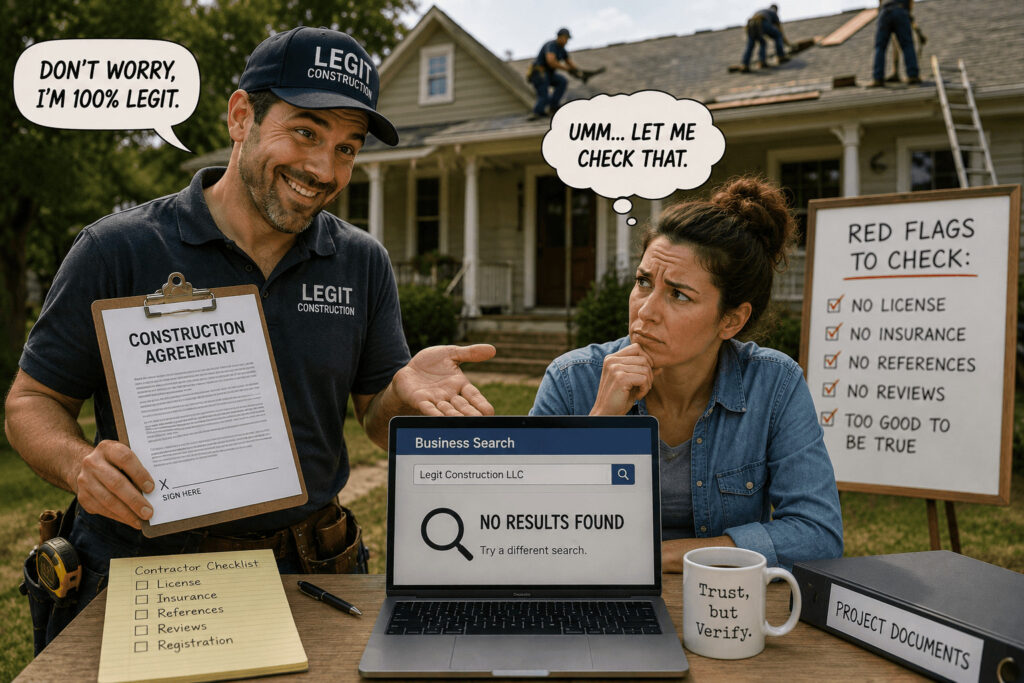
Before Signing a Construction Agreement
Someone came to Contract Clarus asking to look through a construction agreement that she and her fiancée signed. The reason that she asked for assistance to review the construction agreement was because the company had threatened her and her fiancée stating that they were going to charge for services, and they couldn’t back out of the agreement.
She had recently experienced some hail damage on her roof and had received an insurance claim for the damage. After receiving the money for her insurance claim, she immediately began looking around for a general contractor that could do roof repair work. She said one of her neighbors had a sign in their front yard advertising a local roofing company. She called the local roofing company, asked for a quote and her fiancée signed the construction agreement.
Verifying the Contractor
The first thing to do is search the Colorado Secretary of State Website for this company. Also check DORA (Department of Regulatory Agencies). The example referenced is applicable in the state of Colorado. Depending on which state you live in, doing roof repair work is a trade skill and could require a license that verifies that the company is in good standing and maintaining any necessary licenses. Other states don’t require any registration with regulatory authorities. It is the responsibility of the customer to do their research and verify that the company exists before signing a contract for work.
The company that her fiancée signed a construction agreement with did not exist on the Colorado Secretary of State website. That told me that this company was fake. The lesson learned was that the construction agreement was never enforceable. For a contract to be enforceable it must be for a legal purpose, and scamming people out of money is not a recognized legal purpose.
Understanding Quality, Warranties, and Buyer Responsibility
As the buyer in a construction agreement, it is your responsibility to demand a certain level of quality. We are currently experiencing a labor shortage, and construction has been a problem for several years. Many of the small construction companies will hire undocumented workers or workers with no professional skill set at the expense of the quality of service and/or product. The buyer will probably pay a lower rate, but you’re not guaranteed to get the quality of work that you expect. Don’t be ignorant of the risks. The worst thing for you to do is to remain silent.
If the construction agreement doesn’t include warranties, the construction company isn’t willing to stand by the quality of their work and can’t verify that they vetted all their employees or vouch for their craftsmanship don’t sign that agreement. If it’s too good to be true, it probably is. This is not the same situation as cell phone agreements. This is not a “accept services as is” contract. This is a bilateral contract that requires both parties to honor their obligations. The buyer agrees to accept and pay for services. The seller agrees to transfer and deliver services. You have significantly more options of taking legal action against the contractor who contracted the services you needed. And the contractor has that same right to take legal action against you for not paying for services rendered.
Budget, Scope Creep, and Contingency
As the buyer you need to be realistic with your budget. You need to assume that there will be scope creep. This is when the cost exceeds your original budget. Construction projects are very unpredictable. Very rarely do they finish on time and on budget. Assume that there will be unforeseen expenses. There should always be a 15-20% contingency fee built into the cost estimate to account for unforeseen expenses. If the contractor doesn’t include a contingency fee, that is a red flag. Walk away from that contractor because they clearly don’t understand the cost drivers of that construction project. If they don’t understand how to create a budget, then they don’t have the professional mindset required to operate a reputable business.
Key Takeaways
Do your research on any general contractor that you consider for services. Make sure that the general contractor is a legitimate company and has conducted background checks on employees including verifying their professional qualifications. Not all states have licensing requirements. Make sure that the general contractor is in good standing on the Secretary of State website. You can also check the Better Business Bureau for previous reviews and complaints. For anyone outside of the U.S. check your local regulations for verifying a construction business.
Continue Building Contract Literacy
Want to better understand the contracts connected to home projects, business services, or contractor relationships? Contract Clarus helps individuals and small business owners build contract literacy so they can better understand responsibilities, obligations, and risks before issues arise.